In short
- HomeStars Ottawa: lots and entrances $150–$300+ a visit, commercial work $100–$250+ an hour.
- Ontario law: an injury claim over snow or ice needs written notice within 60 days, to the occupier or its snow contractor.
- Ontario Fire Code: fire access routes ready for fire trucks at all times; exterior passageways, stairways and fire escapes of occupied buildings kept free of snow and ice.
- City snow disposal sites take snow from public property only. Lot snow stays on site or is hauled to an authorized site.
Typical prices in Ottawa
| Job | Typical range | Notes |
|---|---|---|
| Parking lot and entrances, per visit | $150–$300+ | HomeStars Ottawa page; larger properties billed hourly |
| Commercial or heavy-equipment work, hourly | $100–$250+/h | HomeStars Ottawa page |
| Plowing, small commercial | $75–$150/h | HomeStars Ottawa page; more for large lots and storms |
| Ice management and de-icing | $90–$180/h | HomeStars Ottawa page, or per application |
| Commercial parking lot plowing, per visit | $100–$500 | HomeStars Canada-wide page |
| Commercial season contract | $1,000–$5,000 | HomeStars Canada-wide page |
Sources. Ottawa ranges: HomeStars, Snow removal companies in Ottawa, section ‘What are the average costs of snow removal in Ottawa?’, seen 29.10.2026. Canada-wide: HomeStars, Snow removal pros, cost section, seen 29.10.2026. Liability: Ontario, Occupiers’ Liability Act, ss. 3, 6 and 6.1, seen 29.10.2026. Fire routes and exits: Ontario Fire Code, O. Reg. 213/07, Div. B, 2.5.1.2, 2.5.1.3 and 2.7.1.8, seen 29.10.2026. Contracts: Ontario, Consumer Protection Act, 2002, s. 1, seen 29.10.2026. Salt practice: Partners in Project Green and TRCA, Sustainable Salt Management Checklist, seen 29.10.2026. City rules: City of Ottawa, Clearing snow from your property and SNOW KNOWledge brochure, By-law 2002-189, Schedule 4, seen 29.10.2026. Snowfall: Environment and Climate Change Canada, Canadian Climate Normals 1981–2010, Ottawa Macdonald-Cartier Int’l A, via the ECCC climate normals data service, seen 29.10.2026. Published ranges are typical prices; the company that calls you quotes its own.
The lots this page is for
A strip plaza with a dozen spaces, a church lot busy on Sunday morning, a clinic, a daycare drop-off loop, a small apartment lot. HomeStars describes commercial work as lot plowing, loading dock clearing, and open entrances and emergency exits.
The hours set the job. A plaza opens when the first employee parks; a church needs its lot on a different day. Put the opening time in the request, and which part fills first.
Five ways a lot is priced
- Per push. HomeStars Ottawa: $150–$300+ a visit for lots and entrances.
- Hourly. $100–$250+ for commercial or heavy-equipment work; $75–$150 for small commercial plowing.
- Per event. One fixed sum per storm, however many passes, with standby time as an extra.
- Season sum. $1,000–$5,000 Canada-wide. The Ottawa page notes a season contract often brings priority service and helps avoid higher emergency or after-hours rates.
- Salt. Per application by area and material, or $90–$180 an hour.
A per-push bill rises with every storm; a season sum holds unless the contract caps snowfall. See trigger depth.
Salt and the cold-day plan
A Sustainable Salt Management Checklist from Partners in Project Green and the Toronto and Region Conservation Authority lists what to ask of a winter contractor:
- plow first, then salt at a measured rate, about 58 g per square metre in a moderate event (roughly 6.5 kg for 100 m²);
- a plan for days below −7°C, when salt works less well;
- pre-wetted salt, brine or low-chloride products where offered;
- unused corners and quiet entrances closed for the winter;
- leftover salt swept up after the melt.
The checklist warns that paying by the amount spread can reward spreading more; a season sum or a fixed sum per event rewards using less. It names Smart About Salt Council certification, an Ontario program, as one sign of a trained contractor. Products: salting and sanding.
The owner’s duty and the visit log
The Occupiers’ Liability Act gives the occupier a duty to take reasonable care that people on the premises are reasonably safe. Section 6 shields an occupier from a hired contractor’s negligence when it acted reasonably in choosing a competent contractor and checking the work.
That is why commercial contracts carry a visit log: time, areas cleared, material spread. Agree who keeps it, for how long, and who reads a notice under the 60-day rule first.
Fire routes, exits and hydrants
Ontario’s Fire Code says fire access routes must stay unobstructed and ready for fire trucks at all times. Exterior passageways, stairways and fire escapes of occupied buildings must be kept free of snow and ice. The City asks owners to keep hydrants and nearby catch basins clear so meltwater drains. Mark all four on the site plan.
Where the snow goes when the lot fills
The City’s Use and Care of Roads By-law prohibits placing snow on streets, sidewalks, pathways and parks. Its snow plow contractor rules make it an offence to dump snow on another owner’s property, on public property or on an accessible parking space.
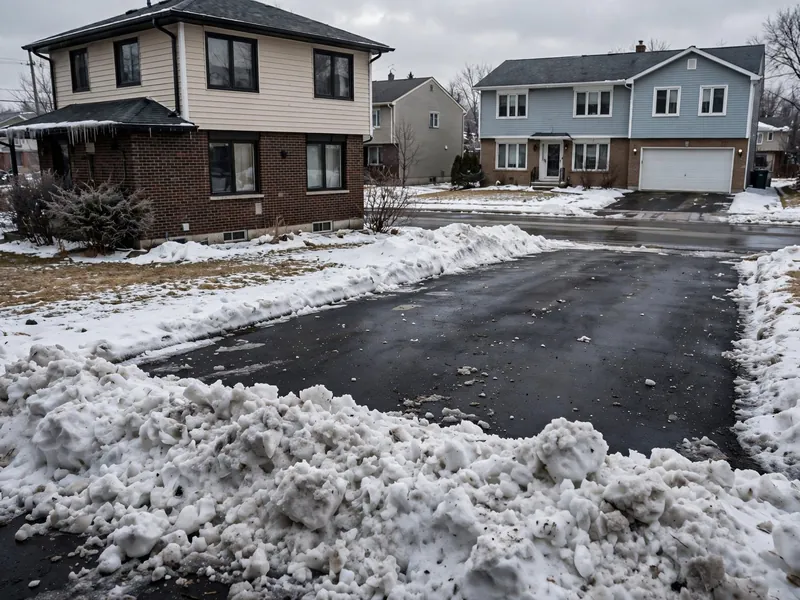
Every pile eats spaces. On a tight plaza lot, late-winter piles can need a loader and trucks; see snow hauling, and ask for the hauling rate in the first quote.
What the contract should list
- Pricing form, starting depth, season dates.
- Open-by time and order of work: entrances, accessible spaces and fire route before the rows.
- Salt material, rate, billing, and the plan below −7°C.
- Walkways, steps and ramps by hand: included or extra.
- Pile locations, the hauling price, the visit log and who handles a notice.
- Damage to curbs, islands and turf, and spring sweep-up; see snow removal damage.
- Licence, insurance certificate, payment terms and HST.
Who you are dealing with
Ottawa Snow Desk passes your request to one independent local snow company. That company calls you back, looks at the lot, prices the winter and does the work.
Questions to ask the company
- Is your price per push, per event, by the hour or one sum for the season, and what depth starts a visit?
- How is salt billed, and what rate do you spread per square metre?
- Does anyone on the crew hold Smart About Salt Council certification or similar salt training?
- Will you log every visit with the time, the areas cleared and the material spread?
- Can I see your City snow plow contractor licence and your insurance certificate?
Have this ready for the call
- A site plan or aerial screenshot with the lot, walkways, entrances and loading door marked
- The hour the first staff, tenants or worshippers arrive, weekdays and weekends
- Where piles may go, and what must stay open: accessible spaces, fire route, hydrant, catch basins
- Curbs, islands, speed bumps and light bases a blade could catch
- Last winter's contract or invoices, and who signs for the property
Questions people ask
Does a church or non-profit lot count as commercial work?
The crew prices it by size, surface and opening hours. Ontario’s Consumer Protection Act defines a consumer as an individual acting for personal, family or household purposes, and excludes anyone acting for business purposes. An organization signing for its lot sits outside that definition, so the written terms carry the weight.
What is the 60-day notice rule for snow and ice injuries?
Section 6.1 of the Occupiers’ Liability Act: a claim for injury caused by snow or ice needs written notice within 60 days, with date, time and location, served in person or by registered mail on the occupier or its snow contractor. Each must pass the notice to the other. A judge can excuse a late notice for a reasonable excuse when the defence is unharmed.
How many visits does an Ottawa winter bring?
Ottawa airport’s 1981–2010 normals show snowfall of 0.2 cm or more on about 63 days a year, 5 cm or more on about 15, and 10 cm or more on about 5. Snow days outnumber 5 cm days about four to one.
Can the crew take lot snow to a City snow dump?
The City says its disposal facilities take snow from public property only, and private operators cannot use them. Hauled snow goes to an authorized disposal site.
How do I check the company's City licence?
Under City rules, a vehicle-based snow business carries an orange plate with a valid annual sticker, its name and phone number on both sides of the vehicle, and at least $2 million of liability insurance. Ask for proof of licence, or check the list at ottawa.ca/consumerawareness.