In short
- HomeStars' Ottawa page puts ice management at $90–$180 an hour, or a price per application by area and material.
- Two Ottawa firms publish salting prices: $65 + HST per application at one, $25 per application for walks and steps at the other.
- Ottawa Riverkeeper says rock salt loses effect below -7°C and stops working below -10°C.
- A concrete industry guide says to keep calcium and sodium chloride off concrete in its first year.
Typical prices in Ottawa
| Job | Typical range | Notes |
|---|---|---|
| Ice management and de-icing, Ottawa | $90–$180 an hour | HomeStars Ottawa page; can also be priced per application by surface area and materials |
| Residential salting, per application | $65 + HST | One east-end Ottawa firm’s published services page |
| Walkway, step and sidewalk salting, per application | $25 | One Ottawa firm’s published list; applied only when the service agreement authorizes it |
| Driveway salting with snow clearing | Included | Same firm’s list: no extra charge on its seasonal and one-time driveway service |
| Sanding, grit or mixed product | Price is set after a look at the job | No published Ottawa per-visit price found |
Sources. Ottawa range: HomeStars, Snow removal services in Ottawa, cost section and FAQ on ice management, seen 29.10.2026. Per-application prices: one east-end Ottawa firm’s services page and one Ottawa firm’s pricing page, seen 29.10.2026. Contract clause: one Kanata–Stittsville firm’s terms and conditions, seen 29.10.2026. City: Salt and abrasive materials (grit), seen 29.10.2026. Temperature and amounts: Ottawa Riverkeeper, 5 Tips to Reduce Your Road Salt Use (29.01.2024) and Take action on road salt overuse (27.01.2025), seen 29.10.2026. Environment: Environment and Climate Change Canada, Road salts FAQ, seen 29.10.2026. Concrete: NRMCA, Concrete in Practice 2, Scaling Concrete Surfaces, file hosted by a US ready-mix supplier, seen 29.10.2026. Pets: Ottawa Humane Society, cold snap advice (December 2024) and Protect pets from cold temperatures this winter, seen 29.10.2026. Ontario: Occupiers’ Liability Act, ss. 3, 6 and 6.1 and Your rights when signing or cancelling a contract, seen 29.10.2026.
Salt, sand and grit do different jobs
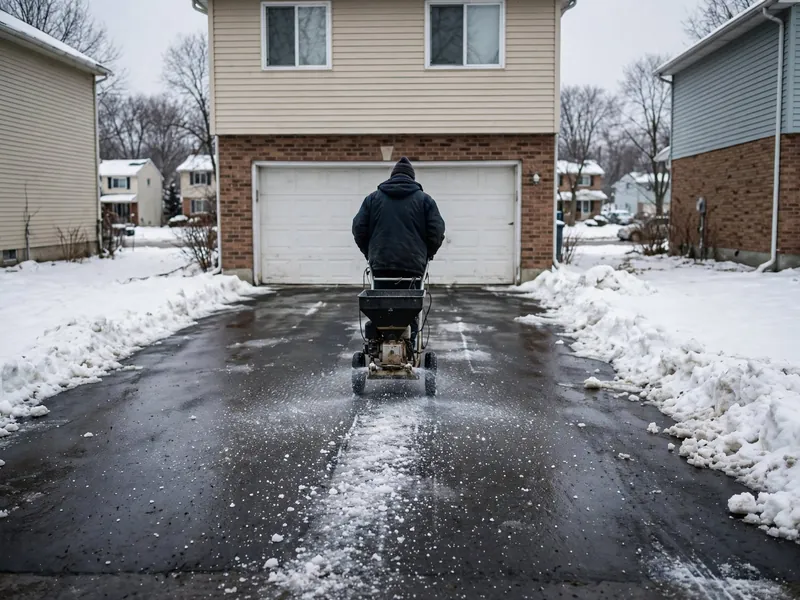
Ottawa Riverkeeper explains that salt dissolves into water and lowers its freezing point, so it works on a cleared surface before ice forms. Sand and gravel give grip on ice already there.
The City of Ottawa makes the same split on streets: dry salt, wet salt and brine early in a storm to keep ice from bonding to asphalt, and abrasive grit in colder temperatures when salt stops working. A company treating your property makes that choice on a smaller scale.
The temperature on the bag
Rock salt is sodium chloride. Per Ottawa Riverkeeper, it starts to lose effect below -7°C and is too weak to bother with below -10°C. The cut-off depends on the kind of salt, so ask which product the crew carries, the lowest temperature on its label, and what goes down when the forecast drops past it.
How Ottawa companies price it
HomeStars’ Ottawa page lists ice management at $90–$180 an hour, or per application by area and materials, and says some services include salting while others charge apart. One east-end firm lists residential salting at $65 + HST per application. Another includes driveway salting with each clearing visit and bills walks and steps at $25 per application.
The price moves with the area treated, the number of steps, the product, how often salt goes down and whether it rides along with clearing or needs its own trip. Full clearing prices are on the snow removal cost page; walk and step shovelling is on the walkway and steps page.
Who decides when salt goes down
One Kanata–Stittsville firm’s terms leave salting, sanding and de-icing out unless named, make the homeowner decide when and how much ice-melting product goes down, and exclude claims from a failure to apply it. HomeStars notes that some Ottawa services include salting and others charge separately. Pick one model and get it in writing: after each clearing, on request, or a set number per season.
Ontario’s Occupiers’ Liability Act puts a duty of reasonable care for visitors on the occupier. Section 6 shields an occupier who acted reasonably in hiring a competent contractor from liability for that contractor’s negligence on that account. Under section 6.1, a snow or ice injury claim needs written notice within 60 days to the occupier or the snow contractor. A clear salt clause shows who was meant to act. The seasonal contract page covers the rest of the agreement.
Concrete, interlock and the lawn edge
NRMCA’s Concrete in Practice 2 links scaling, the flaking of a concrete surface, to freeze-thaw cycles and heavy calcium or sodium chloride on weak or poorly cured concrete. Its advice: keep those salts off new concrete for the first year, use clean sand, then salt sparingly. Ammonium sulfate and ammonium nitrate, found in fertilizers, attack concrete, and salty water standing on a poorly drained slab worsens damage. For pavers and stamped concrete, see interlock driveways.
Environment and Climate Change Canada says heavy road salt use can damage vegetation and soil organisms, and almost all chloride reaches waterways. Ottawa Riverkeeper’s five-year monitoring found chloride in most local streams above acute toxicity thresholds after winter events. Note shrubs and beds along the walk.
What the quote should list
- The product by name, and what goes down below its working temperature
- Each surface, with the number of steps
- The price per application or per hour, or the season line that covers salt
- When salt goes down, any limit per season and the charge beyond it
- HST and the total
Under Ontario’s Consumer Protection Act, most agreements over $50 must be in writing. A written estimate in the contract caps the final price at 10% above it unless you sign a change, and a contract signed at home has a 10-day cooling-off period.
Who you are dealing with
Ottawa Snow Desk passes your request to one independent local snow company. That company calls you back, prices the salting or sanding and does the work.
Questions to ask the company
- Which product goes on my surfaces: rock salt, a blend, sand or grit, and what is the lowest temperature on its label?
- Is salting priced per application, by the hour or inside the season price, and which surfaces does that cover?
- Who decides when salt goes down: your crew after each clearing, or me with a call each time?
- What goes on concrete poured in the last year, and on interlock or stamped concrete?
- Can the product, the surfaces, the price per application and the total with HST go in the written contract?
Have this ready for the call
- A list of the surfaces to treat: driveway, front walk, steps, porch, side path to a back door
- Photos of the steps and of any spot where meltwater refreezes, such as below a downspout
- What each surface is made of, and the year of any concrete poured in the last twelve months
- Pets in the house, and garden beds or shrubs that border the walk
- Your current clearing contract, if you have one, and whether it mentions salt or ice
Questions people ask
Does salt still work in an Ottawa cold snap?
Less and less. Ottawa Riverkeeper says rock salt starts to lose effect below -7°C and is ineffective below -10°C. On streets, the City turns to abrasive grit in that cold. Ask the company what it puts down on a -20°C morning.
What does sand do on ice?
It gives boots grip on ice already there, and melts nothing. Ottawa Riverkeeper adds that leftover gravel can be swept up in spring and used again.
Is salt on the walk a problem for my dog?
The Ottawa Humane Society advises wiping a dog’s paws after each walk to remove salt, sand and other chemicals made to melt ice and snow. Mention pets in your request so the company can say which product it uses near the door.
Can a crew salt a driveway poured this year?
A concrete industry guide (NRMCA, Concrete in Practice 2) says to keep calcium and sodium chloride off concrete in its first year, use clean sand for traction, then use salt sparingly. Give the pour date in your request.
How much salt is the right amount?
Ottawa Riverkeeper gives about 2 tablespoons per square metre, roughly a coffee mug for a two-car driveway, and says more than seven grains under one footstep is too much. Use it to judge what the crew leaves behind.